You Won’t Believe What This Thai Temple Hides in Plain Sight
Chiang Rai isn’t just another stop on the Thailand trail—it’s where architecture dares to dream. I walked into what looked like a regular temple compound and walked out questioning reality. Bright mosaics, twisted spires, and buildings that laugh at tradition—this place doesn’t follow rules. If you think you’ve seen Buddhist temples before, think again. Chiang Rai’s architectural wonders aren’t just beautiful; they’re stories carved in concrete, color, and courage.
The White Temple That Shatters Expectations
Wat Rong Khun, commonly known as the White Temple, stands as one of the most visually arresting religious sites in Southeast Asia. Unlike the gilded spires and golden Buddhas typical of Thai temples, this sanctuary is entirely white—its surface shimmering like fresh snow under the northern Thai sun. The temple was conceived and funded entirely by Chalermchai Kositpipat, a renowned Thai artist who dedicated his life and earnings to its creation. Beginning in 1997 on land donated by his family, Chalermchai envisioned a place that would not only honor Buddhist principles but also challenge how those ideals are expressed through architecture.
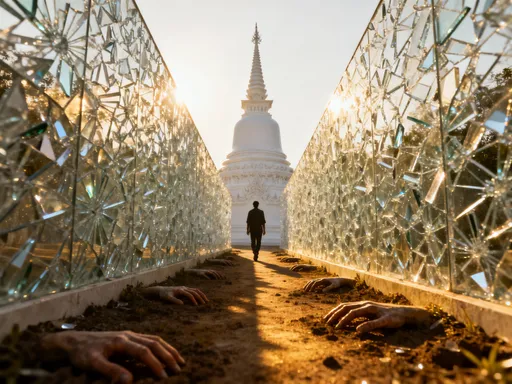
Every inch of Wat Rong Khun is intentional. The gleaming white exterior symbolizes the purity of the Buddha’s teachings, while the countless pieces of broken mirror and glass embedded into the façade reflect light like countless watchful eyes—representing the all-seeing wisdom of enlightenment. As visitors approach, they must cross a bridge over a pit filled with sculpted hands reaching upward—symbolizing the suffering of desire and the struggle to escape the cycle of rebirth. This dramatic entry sets the tone: this is not merely a place of worship, but a journey through spiritual metaphor.
The fusion of traditional Lanna architecture with surreal modern elements is what makes Wat Rong Khun so unique. While the multi-tiered roof and naga serpent balustrades nod to northern Thai heritage, the overall form defies convention. Spindly spires twist skyward like frozen flames, and the absence of gold—a hallmark of most Thai temples—forces a reevaluation of what sacred beauty looks like. Chalermchai’s vision was never to replicate the past, but to create a living art piece that speaks to contemporary minds.
The sensory experience deepens upon closer inspection. Morning light bathes the temple in a soft glow, causing the mirrored fragments to sparkle like scattered stars. The air is still, broken only by the occasional chime of wind bells and the quiet footsteps of barefoot visitors. There are no loud chants or bustling crowds at dawn—just a profound silence that invites introspection. For many, this moment of stillness is as transformative as the temple’s bold visuals. It’s not just the look of the place that moves people, but the atmosphere it cultivates: one of reverence, wonder, and quiet awe.
Inside the Unconventional: Art as Devotion
Stepping into the ubosot, or ordination hall, of Wat Rong Khun is like entering a different world—one where ancient teachings collide with modern imagery in a striking visual dialogue. The interior walls are covered in elaborate murals painted by Chalermchai himself, blending classical Buddhist iconography with unexpected pop culture references. Here, Superman soars alongside bodhisattvas, Harry Potter casts spells near depictions of meditation, and scenes from the September 11 attacks appear alongside visions of hell. At first glance, these images may seem jarring, even irreverent, but they are deeply intentional.
Chalermchai designed these murals to reflect the moral challenges of the modern world. The presence of global disasters, consumerism, and technological obsession serves as a reminder that enlightenment is not an escape from reality, but a response to it. The artist believes that Buddhist teachings must remain relevant to new generations, and that sacred spaces can—and should—engage with contemporary issues. By placing modern symbols within a religious context, he forces visitors to confront their own attachments, fears, and distractions.
One mural shows a man clutching a mobile phone while being dragged into a fiery underworld, a vivid commentary on digital addiction. Another features Michael Jackson, not as a pop star, but as a figure caught between fame and spiritual emptiness. These images don’t glorify celebrity or tragedy—they use them as parables. Visitors often pause for long moments, some smiling at the audacity, others visibly moved by the depth of meaning. Many report feeling as though the temple is speaking directly to them, challenging their assumptions about faith, art, and the role of religion in daily life.
This bold approach has sparked debate. Some traditionalists argue that such imagery has no place in a temple, while others praise Chalermchai for revitalizing Buddhist art. Regardless of opinion, the effect is undeniable: Wat Rong Khun does not allow passive observation. It demands engagement. It asks questions. And in doing so, it transforms a visit from a tourist experience into a personal reflection on morality, impermanence, and the search for meaning in a complex world.
The Black House: Where Darkness Tells a Story
Just a short drive from the radiant White Temple lies its philosophical counterpart—Baan Dam, or the Black House. Created by another visionary Thai artist, Thawan Duchanee, this complex presents a stark contrast in both color and mood. Where Wat Rong Khun dazzles with light, Baan Dam absorbs it. Its low-slung buildings, painted in deep black and constructed from teak, ironwood, and stone, blend into the shadows like ancient tombs. This is not a home, nor a temple in the conventional sense, but a curated collection of art, artifacts, and architecture that explores the darker facets of human existence.
Thawan, a National Artist of Thailand, designed Baan Dam as a meditation on death, desire, and the duality of human nature. The site includes over 30 structures, many of which house collections of animal skulls, taxidermied predators, and ritual objects from across Asia. Walking through the compound feels like moving through a dreamscape—dimly lit corridors, heavy wooden doors, and the occasional glimpse of a buffalo skull mounted on a wall. There are no bright colors, no reflective surfaces—only textures of wood, stone, and bone that speak to impermanence and the rawness of life.
Unlike the uplifting message of Wat Rong Khun, Baan Dam does not offer comfort. Instead, it embraces discomfort as a path to understanding. The near-absence of natural light in many rooms forces visitors to slow down, to feel their way through spaces that seem to breathe with silence. This intentional design creates a meditative, almost somber atmosphere. Some describe the experience as confronting the shadow self—a necessary step in any spiritual journey. The black structures, inspired by traditional northern Thai and Lanna architectural forms, are reinterpreted through a minimalist, almost monastic lens, stripping away ornamentation to focus on essence.
Baan Dam challenges the expectation that sacred or artistic spaces must be beautiful in a conventional sense. Here, beauty lies in honesty—in the acknowledgment of mortality, suffering, and the primal instincts that underlie civilization. For many visitors, especially those familiar with the serenity of typical Buddhist temples, the experience is unsettling at first. But with time, a deeper appreciation emerges. The Black House does not seek to uplift through light, but to enlighten through darkness. Together with Wat Rong Khun, it forms a complete philosophical circle: one celebrates purity and transcendence, the other confronts the raw materials from which enlightenment must arise.
Merging Past and Present: The Language of Lanna Reimagined
While the White and Black Houses capture global attention, Chiang Rai’s architectural identity extends far beyond these iconic sites. Across the city, a quiet revolution is underway—one that honors the Lanna heritage while embracing modern functionality and design. The Lanna style, originating from the ancient kingdom of northern Thailand, is characterized by steep, multi-tiered roofs, wide overhanging eaves, intricate wood carvings, and open-air layouts that promote natural ventilation. Today, architects and urban planners are finding innovative ways to preserve this aesthetic in public buildings, museums, and community spaces.
Take, for example, the Chiang Rai Clock Tower or the Provincial Hall—structures that, at first glance, might appear modern but are deeply rooted in tradition. Their sloped roofs mirror the forms of ancient temples, while the use of teak motifs and natural materials grounds them in regional identity. Even newer commercial developments incorporate these elements, ensuring that the city’s skyline remains distinct from the glass towers of Bangkok or Chiang Mai. This conscious effort to maintain architectural continuity is not merely aesthetic; it reflects a deeper cultural pride and a desire to resist homogenization in the face of rapid development.
Young Thai architects are playing a crucial role in this evolution. Trained in international schools but inspired by local roots, they are experimenting with sustainable materials, passive cooling techniques, and adaptive reuse of traditional forms. Some have designed eco-friendly homes that blend Lanna rooflines with solar panels and rainwater harvesting systems. Others have reimagined community centers as open-air pavilions where elders gather, children play, and festivals are held—spaces that function as both social hubs and cultural keepers.
This architectural renaissance is not about nostalgia. It’s about relevance. By integrating traditional design with contemporary needs, Chiang Rai is creating a built environment that feels both familiar and forward-looking. It sends a message: progress does not require erasing the past. Instead, the past can be a foundation for innovation. In a world where cities often lose their character to generic development, Chiang Rai stands as a model of how regional identity can thrive in the modern era.
Hidden Gems: Smaller Temples with Big Personalities
Beyond the famous landmarks, Chiang Rai is dotted with smaller, lesser-known temples that offer a more intimate and authentic experience. Wat Phra Sing, located near the city center, may not have the dazzling façade of Wat Rong Khun, but it exudes a quiet dignity. Its classic Lanna-style viharn (assembly hall) features a gracefully curved roof adorned with golden naga serpents, their heads poised as guardians of the sacred space. Inside, a centuries-old Buddha image sits in serene meditation, surrounded by flickering candles and fresh lotus offerings.
Wat Jong Kham, another hidden gem, sits beside a quiet pond and is often overlooked by tour groups. Its red lacquered doors and golden stupa reflect the traditional aesthetics of northern Thailand, but what truly defines the temple is its atmosphere. At dawn, the sound of monks chanting drifts through the mist, blending with the gentle croak of frogs. Locals arrive with trays of sticky rice and fruit, placing them at the monks’ feet as an act of merit-making. Children run through the courtyard, laughing, while elders sit in shaded corners, murmuring prayers. There are no entrance fees, no souvenir stalls—just the rhythm of daily spiritual life.
Wat Pa Pao, originally built by the Shan people from Myanmar, adds another layer to Chiang Rai’s cultural mosaic. Its architecture blends Lanna and Burmese influences, with a tiered stupa that rises like a flame and intricate wood carvings depicting Jataka tales. The temple serves as both a place of worship and a cultural bridge, hosting festivals that celebrate Shan traditions. Visitors who take the time to explore these quieter sites often leave with a deeper understanding of Thai Buddhism—not as a spectacle, but as a living, breathing practice woven into the fabric of everyday life.
These temples may lack the shock value of the White or Black Houses, but they offer something equally valuable: authenticity. They are not designed for Instagram photos or viral videos. They exist for the community, for the monks, for the quiet moments of reflection that define spiritual life in northern Thailand. For travelers seeking connection over spectacle, these hidden temples provide a doorway into the soul of the region.
Why Architecture Shapes the Travel Experience
Architecture is more than just background scenery—it shapes how we feel, remember, and understand a place. In Chiang Rai, every structure tells a story, and every visit becomes an emotional journey. The dazzling white of Wat Rong Khun inspires awe and curiosity. The brooding darkness of Baan Dam prompts introspection and humility. The quiet grace of neighborhood temples brings peace and connection. These are not passive experiences; they are designed to evoke specific responses, to guide the visitor through a sequence of emotions and insights.
When travelers walk across the bridge of hands at the White Temple, they don’t just see art—they feel the weight of desire and the longing for liberation. When they step into the dim silence of the Black House, they confront the impermanence that underlies all existence. And when they sit in the shade of a centuries-old viharn, listening to the chants of monks, they touch something timeless. These moments linger long after the trip ends, forming the core of meaningful travel.
Moreover, architecture serves as a visual language of belief. In Chiang Rai, Buddhist principles are not confined to scriptures or sermons—they are built into the walls, carved into wood, and reflected in glass. The layout of a temple, the direction it faces, the materials used, the placement of statues—all carry symbolic meaning. For observant travelers, learning to read these cues transforms a simple visit into a cultural dialogue. It fosters empathy, deepens understanding, and breaks down the barrier between observer and participant.
Thoughtful architectural planning also enhances tourism without compromising authenticity. By balancing iconic attractions with community-centered spaces, Chiang Rai avoids becoming a theme park version of itself. Visitors are encouraged not just to look, but to feel, to reflect, to engage. This approach ensures that tourism supports local culture rather than displacing it—a lesson other destinations would do well to learn.
Planning Your Visit: Practical Insights for a Meaningful Journey
For those planning a visit to Chiang Rai, timing and preparation can make all the difference. The best time to experience the White Temple is early in the morning, ideally between 7:00 and 9:00 a.m. The light is soft, the air is cool, and the crowds are thinner, allowing for a more contemplative experience. Photography is permitted, but visitors are asked to be respectful—no flash near prayer areas, and no climbing on structures. Drones require prior permission and are often restricted near religious sites.
Dress code is important. Shoulders and knees must be covered for both men and women when entering temple grounds. Many visitors bring a lightweight shawl or sarong to drape over their shoulders if needed. While the sites are welcoming to tourists, they remain places of worship, and modest attire shows respect for local customs. Shoes must be removed before entering any building, so wearing slip-on footwear is practical.
To gain a deeper understanding of the symbolism and history behind the architecture, consider hiring a local guide. Many are trained in art, history, or religious studies and can provide context that transforms a visual tour into an educational journey. They can explain the meaning behind the mural of Superman, the significance of the black teak structures, or the origins of the naga serpent design. Their stories add layers of meaning that are not always evident from plaques or brochures.
Finally, balance the major attractions with quieter explorations. Take a walk through residential neighborhoods, visit a morning market, or stop by a small temple where locals gather. These unplanned moments often become the most memorable. Remember, the goal is not to check off a list of sites, but to feel the story behind every beam, every mural, every shadowed corridor. In Chiang Rai, architecture is not just seen—it is felt, understood, and carried home in the heart.
Chiang Rai’s architecture doesn’t just stand—it speaks. From dazzling white temples to brooding black compounds, each structure invites reflection, surprise, and connection. These aren’t monuments frozen in time, but living dialogues between tradition and imagination. To walk through Chiang Rai is to witness a culture confidently redefining itself—one bold, beautiful building at a time.