You Won’t Believe What Hides Behind Vienna’s Walls
Vienna isn’t just about classical music and coffee houses—its architecture will stop you mid-step. I didn’t expect to be so stunned by buildings, but here we are. From golden façades to futuristic bubbles, the city blends centuries in a way that feels almost unreal. This is more than sightseeing—it’s like walking through layers of imagination. Let me take you where stone tells stories and steel dances with light. Every alleyway, plaza, and bridge reveals a moment in time suspended between memory and innovation. Vienna doesn’t erase its past; it layers it, builds upon it, and sometimes, gently reimagines it. For travelers who look beyond the surface, the city’s walls become windows into a living dialogue between emperors, artists, reformers, and dreamers.
First Impressions: A City That Defies Time
Arriving in Vienna, one is immediately struck by the seamless coexistence of eras. The city greets visitors not with a single architectural identity, but with a rich tapestry woven from centuries of design evolution. As you step from the modern arrivals hall of Vienna International Airport into the city’s public transit system, the transition begins—glass and steel give way to cobblestone streets, horse-drawn carriages, and the distant chime of cathedral bells. Yet, just beyond the historic core, sleek high-rises reflect the Danube’s light, and futuristic structures rise like sculptures from urban plazas. This is not a city torn between old and new, but one that embraces both with quiet confidence.
The emotional impact of this contrast is profound. Standing in front of St. Stephen’s Cathedral, its multi-colored tile roof glowing under the sun, you may turn a corner and find yourself face to face with the angular glass façade of the DC Towers, Austria’s tallest buildings. There is no jarring dissonance—instead, a curious harmony. Vienna’s ability to integrate bold contemporary architecture within a historically dense urban fabric sets it apart from other European capitals. While cities like Paris or Prague preserve their historic cores with strict preservation laws that often resist modern intervention, Vienna allows innovation to speak, as long as it listens first.
What makes Vienna truly unique is not merely the presence of old and new, but the intentionality behind their coexistence. Urban planning here is not about preservation at the expense of progress, nor is it about modernization at the cost of identity. It is a continuous negotiation—a dialogue where each new structure is expected to contribute meaningfully to the city’s visual and cultural narrative. This balance is not accidental; it is the result of decades of thoughtful policy, civic engagement, and a deep respect for design as a public good. For the observant traveler, this makes Vienna not just a destination, but an invitation to see how cities can evolve without losing their soul.
The Heart of Old Vienna: Historic Core and Imperial Grandeur
At the center of Vienna’s architectural story lies the Innere Stadt, the historic inner city inscribed as a UNESCO World Heritage site. Encircled by the Ringstrasse, a grand boulevard built in the 19th century over the foundations of dismantled medieval walls, this district is a living museum of European architectural evolution. Walking its streets is like turning the pages of a beautifully illustrated history book—one moment you’re beneath the soaring Gothic spires of St. Stephen’s Cathedral, the next you’re passing a Baroque palace adorned with frescoes and gilded stucco. The layout of the Innere Stadt has remained largely unchanged since the Middle Ages, a testament to the city’s enduring urban structure.
St. Stephen’s Cathedral, or Stephansdom, stands as both a spiritual and architectural anchor. Construction began in the 12th century, and over the following 600 years, the cathedral absorbed the stylistic shifts of its time—Romanesque foundations, Gothic superstructure, and later Renaissance and Baroque additions. Its south tower, rising 136 meters, offers panoramic views of the city, but it is the cathedral’s details that captivate: the intricate stone tracery, the massive iron gates forged in the 14th century, and the roof, covered in 230,000 glazed tiles arranged in the Habsburg family’s coat of arms. Every element speaks of craftsmanship, devotion, and the enduring power of place.
Equally significant is the Hofburg Palace, once the principal residence of the Habsburg dynasty. Expanded over centuries, the complex blends Gothic, Renaissance, and Baroque styles into a sprawling ensemble that includes chapels, museums, and the Spanish Riding School. The Neue Burg, added in the early 20th century, exemplifies the Ringstrasse era’s neoclassical ambitions—massive colonnades, sculpted pediments, and a sense of imperial permanence. These buildings were not merely homes; they were statements of power, designed to impress subjects and rivals alike. The spatial design of the city during this period reflected hierarchy and order, with wide avenues radiating from central points, allowing both grand processions and military control.
Yet, today, these spaces serve a different purpose. The former imperial gardens of the Hofburg are now open to the public, and the Ringstrasse hosts festivals, markets, and daily commutes. This transformation—from exclusive privilege to shared civic life—mirrors Vienna’s broader evolution. The architecture remains, but its meaning has shifted, inviting not just admiration, but participation. For the modern visitor, the historic core is not a frozen relic, but a living, breathing part of the city’s daily rhythm.
Secession Movement: When Art Rebelled in Brick and Steel
In the late 19th century, Vienna stood at a crossroads. The grandeur of the Ringstrasse era celebrated tradition, but a new generation of artists and architects began to question the dominance of historical imitation. In 1897, a group of radical thinkers, including Gustav Klimt, Josef Hoffmann, and Joseph Maria Olbrich, broke away from the conservative Künstlerhaus to form the Vienna Secession. Their goal was not merely to create new art, but to forge a new aesthetic—one that embraced modernity, rejected ornament for its own sake, and sought a synthesis of all arts. Their manifesto declared, “To every age its art, to every art its freedom.” This spirit of rebellion found its most iconic expression in architecture.
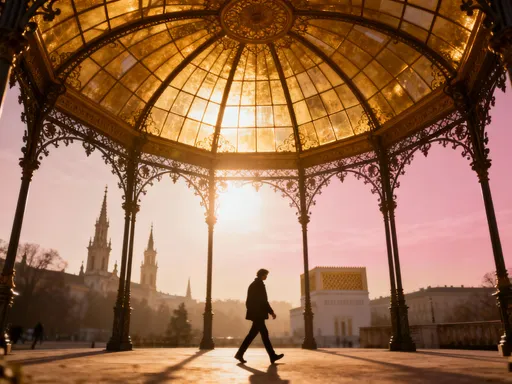
The Secession Building, completed in 1898 and designed by Olbrich, is a manifesto in stone and iron. Its clean white façade, geometric forms, and golden laurel dome—resembling a futuristic crown—stood in stark contrast to the ornate historicism of the time. The dome, composed of 3,000 gilded laurel leaves arranged in a lattice, catches the sunlight and appears to float above the structure. Beneath it, the inscription “Der Zeit ihre Kunst. Der Kunst ihre Freiheit.”—“To the age its art, to art its freedom”—captures the movement’s ethos. Inside, the space was designed as a gallery for contemporary art, with flexible walls and controlled lighting, making it one of the earliest examples of a modern exhibition space.
The building was not just an artistic statement; it was a cultural provocation. Critics mocked it as a “golden cabbage,” but its influence was immediate and lasting. The Secessionists believed that art should be integrated into everyday life, and this principle extended to architecture, furniture, and even typography. Their work laid the foundation for the Wiener Werkstätte, a collective that produced handcrafted objects of exceptional quality and minimalist beauty. In doing so, they helped shift the focus from grand monuments to human-scaled design, from imperial symbolism to individual expression.
The Secession Movement’s legacy is not confined to one building. It sparked a broader rethinking of what architecture could be—functional, expressive, and forward-looking. While short-lived as an organized group, its impact endured, inspiring the next generation of Viennese architects, most notably Otto Wagner, who would carry its ideals into the realm of urban infrastructure.
Otto Wagner’s Vienna: Where Modernity Took Root
If the Secessionists were the poets of architectural change, Otto Wagner was its engineer. A former professor and traditionalist, Wagner underwent a dramatic transformation in the 1890s, embracing the idea that architecture must serve the needs of the modern city. He became a pioneer of functionalism, arguing that form should follow purpose, and that new materials like steel, glass, and aluminum should be celebrated, not hidden. His work on the Vienna Stadtbahn—the city’s early urban rail system—remains one of the most elegant integrations of public infrastructure and artistic design in Europe.
Wagner’s Stadtbahn stations, scattered across the city, are masterclasses in restrained modernity. Take the Karlsplatz Station, now serving as a museum and café: its two entrance pavilions feature sleek green steel frames, glass walls, and decorative elements in gold and floral motifs rendered in iron. The structure is both utilitarian and beautiful, a rare balance. The use of aluminum for decorative panels was revolutionary at the time, and the integration of electric lighting enhanced both safety and ambiance. Wagner did not see infrastructure as mere necessity; he saw it as an opportunity to elevate the everyday experience of the citizen.
Beyond the Stadtbahn, Wagner’s residential buildings exemplify his philosophy. The Majolika House, named for its colorful glazed ceramic tiles, combines functionality with aesthetic delight. The tiles, arranged in floral patterns, serve both as decoration and weather protection. Similarly, the Linke Wienzeile Buildings—apartment complexes designed for the middle class—feature curved façades, asymmetrical balconies, and ornamental ironwork that softens their modern lines. Inside, Wagner prioritized light, ventilation, and efficient layouts, anticipating principles that would later define modernist housing.
Wagner’s influence extended beyond individual buildings. He was one of the first architects to think systematically about urban planning, advocating for zoning, green spaces, and pedestrian-friendly streets. His 1894 plan for a modern Vienna proposed wide avenues, centralized utilities, and a coherent public transit network—many of which were realized in part. Today, he is rightly celebrated as the father of Viennese modern architecture, not because he rejected the past, but because he reinterpreted it for a new age. His work reminds us that progress need not come at the cost of beauty, and that even the most utilitarian structures can carry meaning.
20th Century Shifts: From Bauhaus Echoes to Brutalist Statements
The 20th century brought profound challenges to Vienna—war, political upheaval, and the need for reconstruction. In the post-war decades, the city faced a housing crisis and a demand for rapid, cost-effective construction. This led to the rise of functionalist and later brutalist architecture, styles that prioritized efficiency, durability, and social purpose. While often criticized for their austerity, these buildings played a crucial role in shaping modern Vienna, providing affordable housing and public facilities for a growing population.
One of the most striking responses to this era of rigid modernism came in the form of Hundertwasserhaus, completed in 1985. Designed by artist Friedensreich Hundertwasser in collaboration with architect Peter Pelikan, the building is a joyful rebellion against uniformity. Its undulating floors, irregular windows, and rooftop gardens defy every principle of conventional architecture. Trees grow from windows, golden onion domes rise unexpectedly, and the façade is a mosaic of colored tiles and spirals. There is not a straight line in sight. To some, it may appear chaotic; to others, it is a celebration of individuality and nature’s imperfection.
Hundertwasserhaus was more than an architectural experiment; it was a philosophical statement. Hundertwasser believed that standardized housing dehumanized people, that living in identical boxes suppressed creativity and well-being. He advocated for “a window right”—the idea that residents should have the freedom to design their own windows—and for buildings that coexisted with nature. The crooked floors, he argued, reconnect inhabitants with the organic world, where nothing is perfectly level. While only a portion of the building is open to the public, its presence has inspired a broader conversation about humane design in urban environments.
Other post-war structures, though less flamboyant, also reflect Vienna’s evolving architectural values. The DC Towers, designed by Dominique Perrault and completed in 2013, combine sleek modernism with sustainable technology. The tallest, at 220 meters, features a dynamic façade that adjusts to sunlight, reducing energy consumption. Similarly, the Central Library and City Hall extension integrate glass and steel with respect for their surroundings, ensuring that new buildings do not dominate but converse with the old. This sensitivity to context is a hallmark of Vienna’s approach—innovation is welcomed, but never at the expense of harmony.
Contemporary Wonders: Vienna’s Living Architectural Laboratory
Today, Vienna continues to evolve as a living laboratory of architectural innovation. The city’s commitment to sustainability, social housing, and public space has made it a global leader in urban design. New developments are not isolated projects but integrated components of a larger vision—one that prioritizes quality of life, environmental responsibility, and aesthetic coherence. This is evident in projects like the Seestadt Aspern, a former airfield transformed into a smart city district focused on renewable energy, green mobility, and mixed-use development.
The DC Towers, located in the Donau City district, exemplify this forward-thinking approach. More than just office and residential spaces, they are designed as vertical communities. The first tower includes a public observation deck, restaurants, and conference facilities, making it accessible to residents and visitors alike. Its façade system optimizes natural light and thermal performance, while rainwater is collected for reuse. The towers are connected to the city via efficient public transit, reducing car dependency. Such integration of technology and urban planning reflects Vienna’s broader commitment to creating buildings that serve people, not just profits.
Equally significant is the city’s investment in cultural infrastructure. The Central Library, or Wienbibliothek im Rathaus, combines historic preservation with modern functionality. Housed in a renovated section of the City Hall complex, it offers vast digital resources alongside rare manuscripts, all within a space designed for quiet reflection and study. The architecture supports its purpose—calm, light-filled reading rooms, intuitive navigation, and seamless access to both physical and digital collections. It is a model of how public institutions can be both beautiful and practical.
Digital design tools have also transformed the way architects work in Vienna. Parametric modeling and energy simulation software allow for precise optimization of form, material use, and environmental impact. This has led to buildings that are not only visually striking but also highly efficient. Yet, despite these technological advances, there remains a strong emphasis on craftsmanship and human scale. Even the most futuristic structures are designed with pedestrians in mind, with inviting entrances, shaded walkways, and green spaces woven throughout. This balance between innovation and empathy is what makes contemporary Vienna so compelling.
Hidden Layers: Off-the-Beaten-Path Gems Most Tourists Miss
Beyond the famous landmarks, Vienna reveals its deepest architectural secrets to those who wander slowly and look closely. Tucked away in quiet courtyards, side streets, and repurposed industrial zones, there are treasures that most guidebooks overlook. The Metzleinstaler Hof, for example, is a 16th-century courtyard complex in the first district, now home to artists’ studios and small galleries. Its weathered stone arches and ivy-covered walls offer a glimpse into the city’s medieval past, yet it pulses with creative energy today.
Modernist churches, often overlooked by tourists, are another hidden delight. The Dreifaltigkeitskirche in Ottakring, designed by Clemens Holzmeister in the 1930s, features a striking bell tower and minimalist interior that blends sacred symbolism with clean lines. Similarly, the Kirche am Steinhof, perched on a hill in the 14th district, is a masterpiece of early modernism by Otto Wagner. Its white façade, golden dome, and integration with the surrounding landscape make it one of the most beautiful psychiatric hospital chapels in the world—a testament to the belief that healing environments matter.
Former factories and warehouses have also found new life. The WUK, once a coffin factory, now serves as a cultural center hosting concerts, exhibitions, and theater. Its raw brick walls and industrial beams have been preserved, creating a space that honors its past while embracing the future. Such adaptive reuse projects are increasingly common, reflecting Vienna’s commitment to sustainability and memory.
For the attentive observer, architectural beauty is not confined to monuments. It appears in the ornate door knockers of 19th-century apartment buildings, the hand-painted tiles in subway stations, the spiral staircases hidden in inner courtyards. These details invite a slower, more intimate way of traveling—one that values discovery over checklist tourism. By looking up, pausing, and noticing, visitors connect not just with buildings, but with the lives they have sheltered.
Conclusion: Why Vienna’s Architecture Is a Dialogue Across Centuries
Vienna’s architecture is not a collection of isolated styles, but a continuous conversation across time. Each era speaks, and each new structure listens before responding. From the Gothic spires of St. Stephen’s to the golden dome of the Secession, from Wagner’s elegant stations to Hundertwasser’s whimsical rebellion, the city demonstrates that progress and preservation are not opposites, but partners. This dialogue is what gives Vienna its unique character—a place where history is not buried, but built upon.
The city offers a model for urban evolution that other capitals would do well to study. Growth does not require erasure. Innovation does not demand rupture. By respecting context, prioritizing public good, and valuing design as a form of civic expression, Vienna shows how cities can remain dynamic without losing their identity. Its architecture is not just for experts or tourists; it is for everyone who walks its streets, takes the tram, or sits in a park beneath a plane tree.
To truly experience Vienna, one must look up. Let your eyes trace the curve of a balcony, the pattern of a tile, the way light reflects off a modern façade. Wander beyond the main squares, explore quiet courtyards, and allow the buildings to tell their stories. In doing so, you don’t just see a city—you engage with its soul. And in that moment, you understand why Vienna’s walls are not barriers, but gateways to a deeper, more beautiful way of living.